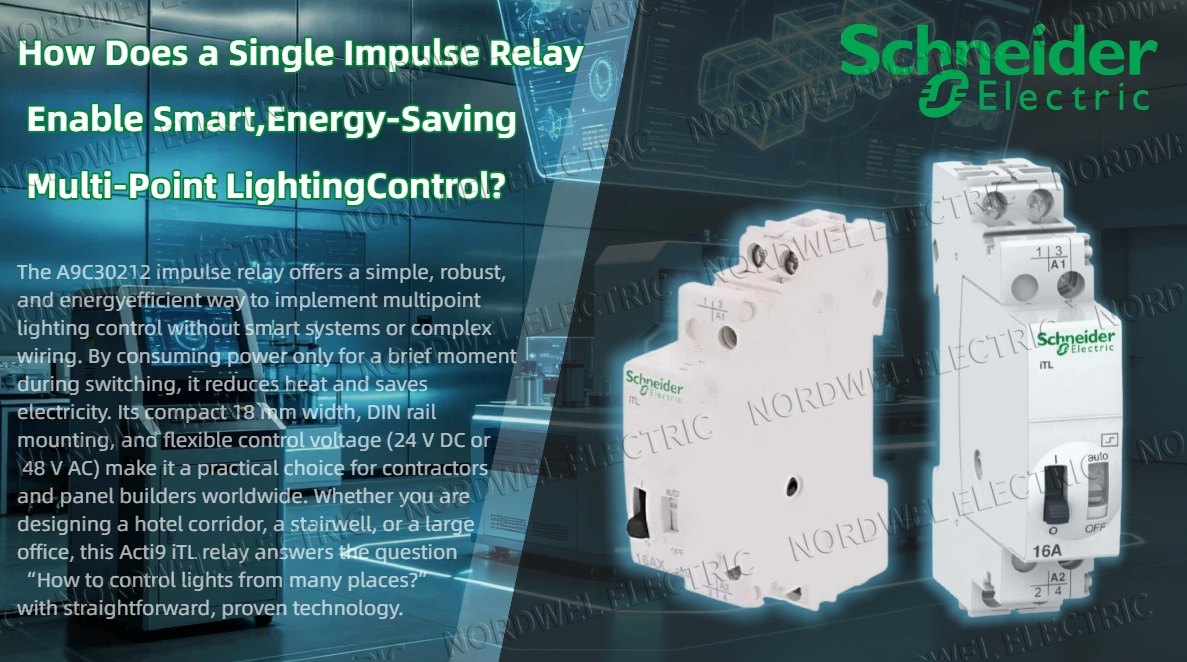
The A9C30212 impulse relay offers a simple, robust, and energy-efficient way to implement multi-point lighting control without smart systems or complex wiring. By consuming power only for a brief moment during switching, it reduces heat and saves electricity. Its compact 18 mm width, DIN rail mounting, and flexible control voltage (24 V DC or 48 V AC) make it a practical choice for contractors and panel builders worldwide. Whether you are designing a hotel corridor, a stairwell, or a large office, this Acti9 iTL relay answers the question “How to control lights from many places?” with straightforward, proven technology.
Understanding the Purpose and Core Benefit of the A9C30212
The Schneider Electric A9C30212 is a two-pole (2P) impulse relay from the Acti9 iTL series, designed with two normally open (2 NO) contacts. It is a compact modular device that toggles its output state each time it receives a short electrical pulse, making it ideal for controlling lighting circuits from multiple locations without complex wiring.In long corridors, staircases, or large rooms, users often want to turn lights on or off from three, four, or even more switches. Conventional two-way switching becomes expensive and messy when more than two switch points are required. The impulse relay solves this problem: it accepts an unlimited number of parallel momentary push-buttons, and the relay itself stays in its last position without consuming any holding current – a feature often called “zero energy consumption”.
This relay is the perfect choice whenever a lighting circuit requires more than two control points, or when you want to centralize control using a “pilot line” together with auxiliaries like iTLc or iATLc+s. Typical projects include hotel corridors, office open-plan areas, apartment building stairwells, and even small commercial shops where one push-button near the entrance and another near the back door control the same set of lights.
Power terminals accept rigid copper cables from 1.5 to 4 mm² or flexible cables with ferrules. Control terminals A1/A2 accept wires from 0.5 to 4 mm². The tightening torque is 1 N·m for both power and control circuits, and the wire stripping length is 11 mm. Switching frequency should not exceed 5 operations per minute or 100 operations per day, and the electrical endurance is 200,000 cycles for AC-21 loads or 100,000 cycles for AC-22 loads. Operating temperature ranges from –20°C to +50°C, with storage from –40°C to +70°C.


سلب مسئولیت:
Nordwel قطعات اتوماسیون صنعتی، از جمله محصولات جدید و محصولات متوقف شده را می فروشد و چنین محصولات برجسته را از طریق کانال های مستقل خریداری می کند. Nordwel یک توزیع کننده، توزیع کننده یا نماینده مجاز محصولات برجسته در این وب سایت نیست. کلیه نام های محصول / تصاویر محصول، علائم تجاری، مارک ها و آرم های مورد استفاده در این وب سایت متعلق به صاحبان مربوطه می باشد. شرح، شرح یا فروش محصولات با این نام ها، تصاویر، علائم تجاری، مارک ها و آرم ها فقط برای اهداف شناسایی است و به هیچ عنوان به هیچ عنوان به هیچ عنوان ارتباط یا مجوزی با هیچ صاحب حقی ندارد.